Information and the Three Worlds View in Science and the Bible
Hartmut Ising
1 Introduction
Einstein realized that the equations of General Relativity implied an expanding universe and therefore pointed toward a beginning. He introduced the cosmological constant in an attempt to avoid this conclusion. He later described this as “my biggest blunder” (“Das war meine größte Eselei”).
Having read this, I turned to the Bible in search of passages that might contribute to a deeper understanding of nature, and I found information to be a particularly suitable subject.
The significance of information in the physical world was emphasized by J. A. Wheeler [1]. He coined the expression “It from bit” and explained:
“It from bit symbolizes the idea that every item of the physical world has at bottom – at a very deep bottom, in most instances – an immaterial source and explanation; that what we call reality arises in the last analysis from the posing of yes-no questions and the registering of equipment-evoked responses; in short, that things physical are information-theoretic in origin.”
The importance of information, however, has also been recognized by biblical scholars for many centuries. The Bible describes God’s creative activity as an act of speaking. In the Gospel according to John, the Word is even identified with God: “In the beginning was the Word, and the Word was with God, and the Word was God.”
This paper examines different aspects of information in connection with the three-worlds view. On the basis of research concerning experiences associated with cardiac arrest, it considers the possibility that consciousness may perceive visual and auditory information independently of normal brain function. It then discusses a possible relationship between the mental world and the world described by quantum physics. The photon’s eigen-world is considered, in the framework of Special Relativity, to be independent of time and space and is therefore related conceptually to the world of information. Finally, a hypothetical equivalence between information flux and energy is proposed.
The Three Worlds View
Karl Popper [2] positioned World 2, the world of the Self or Mind, between the physical World 1 and World 3, the world of culture. A somewhat different version was proposed by Sir Roger Penrose [3]: 1) the physical world, 2) the mental world, and 3) the Platonic world of mathematical concepts. The physicist and philosopher C. F. von Weizsäcker [4] added information to this discussion:
“Today mankind starts to become accustomed to the fact that information has to be taken as a third thing beside matter and consciousness. This is a rediscovery of an old truth. It is the Platonic Eidos and the Aristotelic Form in new clothes so that even a man in the 20th century may learn to have some idea of it.”
From a biblical perspective, God created both the temporal and the eternal worlds and is independent of His creation. God’s world is independent of time and space.
Table 1. Different variants of the three-worlds view
Popper [2] | Penrose [3]/Weizsaecker [4] | Bible | |
World 1 | Physical World | Physical World | Temporal World |
World 2 | The Self | Mind | Eternal World |
World 3 | World of Culture | Platonic World of Mathematical Concepts/Information | God´s World |
In Table 1 three varinats of the three-worlds view are compared. The creator is independent of his creation: time and space – his world corresponds to world 3 of Popper, Penrose and Weizsaecker. The human mind belongs to the eternal world. This world was created at the beginning of time simultaniously with our makcroskopic/temporal world.
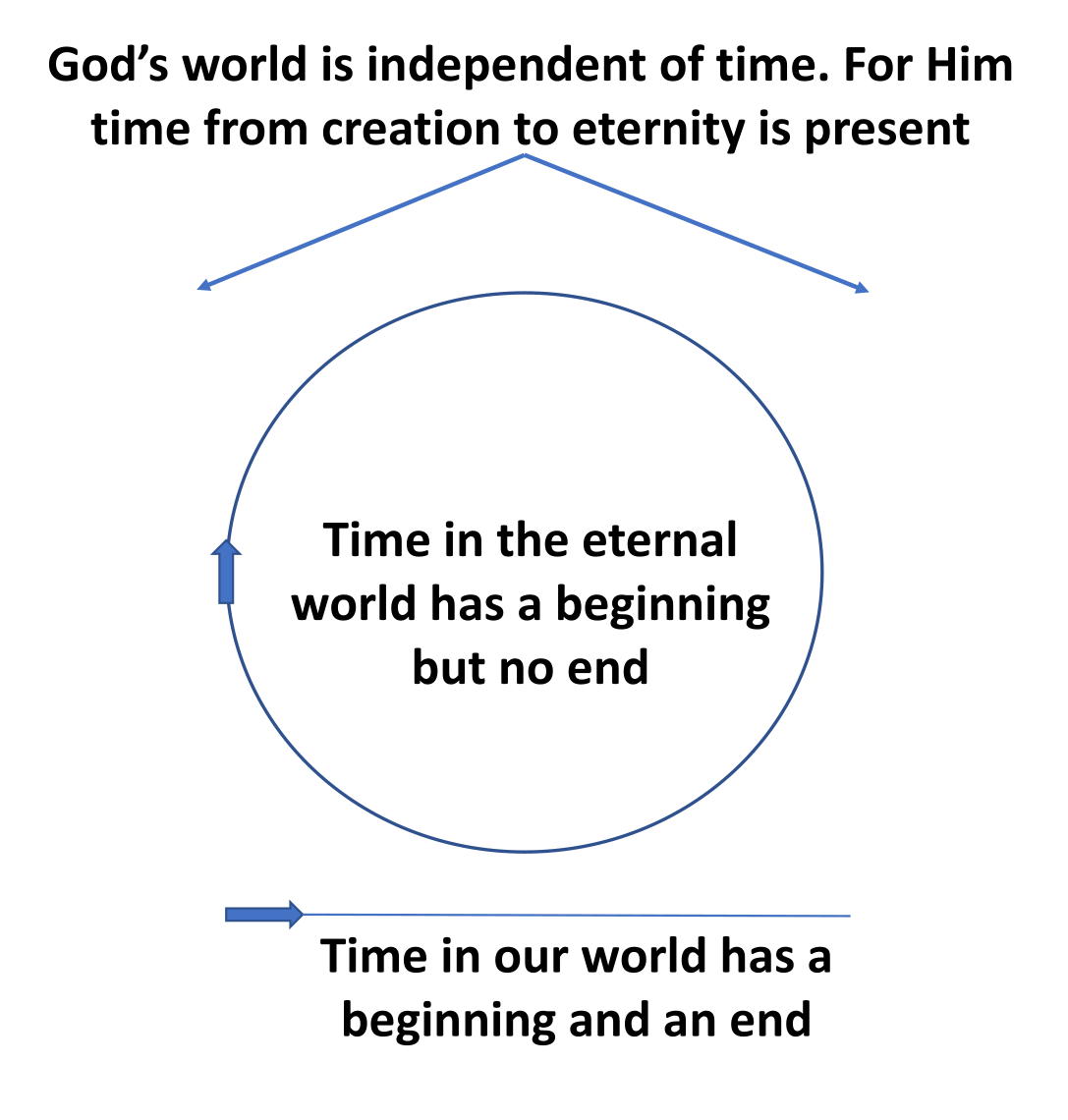
Fig. 1. The Biblical three-worlds view.
2 Three Forms of Information
Three forms of information can be distinguished. The first is pure information or ideas. Creative work begins in the mind. For example, a composer may search for a short melody as the theme for a new composition. Many attempts may be discarded until the final theme is found. This entire process may take place in the composer’s mind before anybody has heard the melody.
The composer then plays the new melody on the piano. Before the first performance, it existed as (1) pure information in the mind. The performed music represents (2) dynamic information – information as a function of time. When the music is recorded, it becomes (3) static information – information stored as a function of space.
“In the beginning was the Word”, these are the opening words of the Gospel according to John. Verse 3 continues: “All things were made by him.” The first sentence of the Bible also refers to a beginning: “In the beginning God created the heavens and the earth.” Are the meanings of these two beginnings identical?
John continues: “and the Word was with God, and the Word was God.” Since God is eternal, this beginning must be distinguished from the beginning of creation. In contrast to God’s planning, Philo of Alexandria argued that God did not create the world at a particular moment in time: “But God is the creator of time” [5].
Therefore, the beginning in John 1:1 is referring to the eternity of God, described in Psalm 90:2: “Before the mountains were brought forth, or ever you had formed the earth and the world, even from everlasting to everlasting, you are God.” Genesis 1:1, by contrast, describes the beginning of time, when God created the temporal world by speaking his word.
In the eternal world, time has a beginning but no end; this is represented in Fig. 1 by a circle with an arrow indicating the beginning. In the temporal world, time has both a beginning and an end and is represented by a straight line.
The eternal world was completed in the moment the Creator’s command was spoken: “He commanded, and it stood fast” (Psalm 33:9). In contrast, the temporal world, which is our universe, is being stretched out: (Zechariah 12:1) the LORD, who stretches forth the heavens. As the guiding principle for biblical interpretation I take Psalm 119:160 (Darby): “The sum of thy word is truth.”
The expansion of the universe was first observed by Hubble and is consistent with Einstein’s General Relativity. We therefore know that the universe has a finite and increasing volume, while remaining unbounded. Space is curved and can be illustrated one dimension lower as the surface of an inflating balloon. As the balloon inflates, distances on its surface increase.
This illustration raises the question: in what space is the universe expanding? My suggestion is that our universe is expanding in the four-dimensional space of the eternal world.
In Revelation 21:16–17, the dimensions of the Heavenly Jerusalem are described: “The length and the breadth and the height of it are equal. And he measured the wall thereof, a hundred and forty and four cubits.” From this description I conclude that the basis of this city is a cube on which the wall is standing and as a consequence the eternal world is 4-dimensional in space.
Information in Planning and Speaking
Philo distinguishes divine planning from the act of creation: “But the seal is an Idea of Ideas, according to which God fashioned the world, being an incorporeal Idea, comprehensible only by the intellect” … “The incorporeal world then was already completed, having its seat in the Divine Logos and the world, perceptible by the external senses, was made on the model of it” [6].
In John 1:1, the Greek word is logos, which can refer to word, reason, plan, or idea. In contrast to the planning, Philo explains the act of creation as God’s speaking: “For God while he spoke the word, did at the same moment create” [7]. Correspondingly, Hebrews 11:3 states: “Through faith we understand that the worlds were framed by the word (rhema: the spoken word) of God, so that things which are seen were not made of things which do appear.”
From this perspective, the act of creation was the pronouncing of the Creator’s command at the beginning of time. A spoken word is a flow of information in time. Psalm 148:5 states: “He commanded, and they were created.” The plan of creation, however, is pure information independent of time.
John Lennox [8] emphasizes the broad significance of information: “Now comes my radical suggestion. I think the time has come to accept both the existence of an ‘information first’ universe and of additional historical informational singularities – at least at the origin of life and the origin of human consciousness. However, information first essentially implies consciousness first – not, of course, human consciousness, but the consciousness of the Mind of God.”
3 Different Worlds With and Without Limitations of Information
In the physical world, information is subject to limitations. A prominent example is Heisenberg’s uncertainty principle, which quantifies a limitation on the simultaneous information that can be obtained about a particle through measurements in the macroscopic world.
Examples of limitations on information transfer in the macroscopic world include the finite resolution of optical imaging systems and the limitation of signal transfer imposed by the bandwidth of electronic circuits.
The smallest length with a physical meaning is commonly identified with the Planck length. Similarly, the shortest duration of time is the Planck time. Thus, within physical theory, length and duration cannot be divided without limit. In mathematics, by contrast, divisibility is unlimited. The laws of physics are expressed using continuum mathematics, whereas information in a digital computer is represented discretely as a series of individual bits.
Zeilinger [9] emphasized “that all knowledge in physics has to be expressed in propositions and that therefore the most elementary system represents the truth value of one proposition, i.e., it carries just one bit of information.”
Combining discrete information with continuum mathematics would require unlimited information, which is impossible for a finite computer. The human mind, however, is capable of dealing with mathematical infinity. This may indicate a fundamental difference between the macroscopic world of the brain and the world of the mind.
The mind has access to another world in which information is unlimited: The Platonic world of mathematical concepts. Penrose [3] wrote:
“Plato made it clear that the mathematical propositions – the things that could be regarded as unassailably true – referred not to actual physical objects … but to certain idealized entities. He envisaged that these ideal entities inhabited a different world, distinct from the physical world.”
He further wrote:
“The mathematical forms of Plato’s world clearly do not have the same kind of existence as do ordinary physical objects such as tables and chairs. They do not have spatial locations; nor do they exist in time. Objective mathematical notions must be thought of as timeless entities and are not to be regarded as being conjured into existence at the moment that they are first humanly perceived.”
The limitations of divisibility and information in World 1 and World 3 of Popper, Penrose, and Weizsäcker are compared in Table 2.
Table 2. Divisibility and information limitations in World 1 and World 3
World 1 | Macroscopic World | Limited divisibility of space and time; limited information and information transfer |
World 2 | Quantum/Mental World | Intermediary |
World 3 | World of Ideas/Mathematics/Information | Independent of time and space; unlimited divisibility and information |
World 1 is termed the “macroscopic world.” In the following discussion, the macroscopic world is distinguished from the “quantum world,” which is placed in the modified three-worlds view together with the mental world as an intermediary between the macroscopic world and the world of ideas, mathematics, and information. The mental World 2 acts as an intermediary between World 1 and World 3. The human mind has the capability to deal with unlimited divisibility and mathematical infinity: “God put eternity into the human heart” (Ecclesiastes 3:11).
4 Information and the Mind–Brain Problem
For a deeper understanding of the mind–brain problem, a broader worldview than naturalism may be necessary. Studies of experiences occurring during cardiac arrest provide relevant scientific observations.
Lommel et al. [10] reported the results of a prospective study of near-death experiences in survivors of cardiac arrest. Three years later, Lommel [11] commented: “During cardiac arrest, the functioning of the brain and of other cells in our body stops because of anoxia … Such understanding fundamentally changes one’s opinion about death, because of the almost unavoidable conclusion that at the time of physical death consciousness will continue to be experienced.”
Sam Parnia subsequently initiated the AWARE study to investigate claims of awareness during resuscitation. He reported: “In the AWARE study, a 57-year-old man described the perception of observing events from the top corner of the room … He accurately described people, sounds, and activities from his resuscitation. His medical records corroborated his accounts …” [12].
In his 2024 book Lucid Dying, Sam Parnia wrote: “The brain is an instrument that relays information to and from both the internal and external worlds, but ‘consciousness’ is a separate and subtle scientific entity that interacts directly with it” [13].
He summarizes numerous reports from patients after recovery from unconsciousness, including descriptions of an expanded and unusually vivid state of consciousness. Such reports are interpreted by Parnia as evidence that consciousness is a separate and subtle entity that interacts with the physical body [13].
5 Quantum Approaches to the Mind–Brain Interaction
Several approaches have been proposed to explain mind–brain interaction through quantum effects. Here, Henry Stapp’s approach is considered.
Stapp wrote: “Orthodox quantum mechanics brings into the dynamics certain conscious choices that are not determined by the currently known laws of physics but have important causal effects in the physical world … The proposed solution … is based on a postulated connection between effort, attention, and the quantum Zeno effect” [14].
Schwartz, Stapp, and Beauregard later argued that quantum equations applied to the brain in the manner suggested by von Neumann can provide a causal account of neuropsychological observations. In their model, mental effort is not merely epiphenomenal but has causal efficacy [15].
Stapp additionally noted that some conscious experiences are associated with approximately 40-Hz synchronous oscillations of electromagnetic fields at multiple brain sites, citing Fell et al. [16].
An interaction between the mind and the quantum world is suggested by Zeilinger’s statement: “The assumption that a particle possesses both position and momentum, before the measurement is made, is wrong. Our choice of measurement apparatus decides which of these quantities can become reality in the experiment” [17].
Combining this statement with Stapp’s proposal that conscious choices may have causal effects in the physical world, one may hypothesize that conscious choices, as events in the mental world, influence quantum processes through the interaction of macroscopic measurement devices with quantum phenomena. Through such interactions, information is transferred from the quantum world into the macroscopic world.
This motivates the following modification of the three-worlds view:
World 2 acts as an intermediary between the macroscopic World 1 and World 3 of ideas, mathematics, and information. The world of quantum physics is associated with the human mind in this intermediary World 2. Measurements themselves, however, are performed in the macroscopic World 1.
According to this modified view, state-vector reduction may be interpreted as the transition from calculations involving complex time to results expressed in real time – a transition from a theoretical description of World 2 to experimental results in World 1. Since measurements are conducted in World 1, our access to the quantum world itself is, from this perspective, limited to a theoretical approach.
From this point of view, the search for a unification of quantum physics and relativity may appear to be a cul-de-sac. This is broadly compatible with Robert Laughlin’s book A Different Universe: Reinventing Physics from the Bottom Down [18], whose German edition bears the subtitle Abschied von der Weltformel (Farewell to the Theory of Everything).
6 The Three-Worlds View and Different Forms of Information
We are familiar with different forms of information: thoughts, spoken words used to express thoughts, and written or recorded words used to store information. The following discussion connects these forms with the three-worlds view.
Penrose [19] quoted a letter attributed to Mozart:
“When I feel well … or in the night when I cannot sleep, thoughts crowd into my mind as easily as you could wish … Those, which please me I keep in my head and hum them … Once I have my theme another melody comes, linking itself with the first one … I keep expanding it, conceiving it more and more clearly until I have the entire composition finished in my head though it may be long.”
The letter describes the creation of a complete composition in the composer’s mind. The author was most probably Mozart, although the authenticity of the letter has been debated. Mozart is documented as having composed without producing extensive preliminary manuscripts.
In the framework proposed here, the composition was first created in the mind in a holistic form, as pure information. It was accessible only to the mind. The mind then transformed this information into a time sequence (“my imagination lets me hear it”), and later humming and writing transferred aspects of it into the macroscopic world.
Thus, after the mental creation of the composition, dynamic information can be interpreted as an intermediary form between pure information and static information stored in World 1. Three types of information can therefore be distinguished.
Table 3. Different forms of information
Pure Information | Information independent of time, space, and physical information carriers |
Dynamic Information | Information as a function of time, or change of information per unit time in a system |
Static Information | Information stored as a function of space (on paper, CD, memory chip, brain, DNA, etc.) |
Table 4 shows the three forms of information in the three worlds.
Table 4. Different forms of information in the three worlds
World 3 | Pure Information |
World 2 | Pure Information; Dynamic Information |
World 1 | Dynamic Information; Static Information |
Static information can be transformed into dynamic information, for example by playing back a stored signal electronically. This process occurs in World 1 and is subject to limitations imposed by the bandwidth of electronic circuits.
World 3 Includes the Eigen-World of Light
Wheeler [1] explained: “When a photon is absorbed, and thereby ‘measured’ – until its absorption, it had no true reality – an unsplittable bit of information is added to what we know about the world.”
Zeilinger [9] added: “The assumption that a particle (e.g. a photon) possesses both position and momentum, before the measurement is made, is wrong. Our choice of measurement apparatus decides which of these quantities can become reality in the experiment.”
In the framework proposed here, before absorption a photon has no definite particle or wave manifestation in our macroscopic world. At the interaction with our world, however, its behavior depends on the experimental arrangement: with a single slit it is detected as a particle-like event; with a double slit it exhibits wave-like behavior.
What, then, is a photon before it is absorbed in the macroscopic world? What is the photon in the “eigen-world” of light?
The Lorentz transformations for time dilation and length contraction are:
Δt = Δt_rest / √(1 − v²/c²)
Δr = Δr_rest √(1 − v²/c²)
For v approaching c, the coordinate transformations become singular. Strictly speaking, Special Relativity does not define a rest frame for a photon. Nevertheless, in the limiting sense, the proper time along a lightlike worldline is zero. Thus, light is not associated with a conventional rest frame in which time and space could be defined as they are for massive objects.
In the present hypothesis, the photon in its eigen-world is therefore described as an “unsplittable” unit of information: 1 bit, independent of a physical carrier. This proposed eigen-world provides a conceptual connection with Penrose’s World 3.
7 Transfer of the Photon’s Information to Our World
An information-theoretic interpretation of Planck’s formula for the energy of a photon is developed here:
E = hν.
The derivation is based on a gedankenexperiment related to Brukner and Zeilinger [20], who concluded that “a single particle in Young’s experiment is just the representative of one bit of information” and that “the most basic notion of quantum mechanics is information.”
Young’s experiment can be interpreted as follows. The transmission of one bit of information from the photon’s eigen-world to the detector is the elementary information flux
i₁ = 1 bit / Δt.
For a quantitative hypothesis, the time interval Δt of this information transfer must be determined.
For this purpose, the gedankenexperiment of Brukner and Zeilinger is modified. Instead of path and interference, energy and time are used as variables. Analogously to their treatment of interference as a dichotomous quantity, the continuous energy is replaced by two possible energy values. This can be achieved using a light source with the a priori information that its frequency is either ν/2 or ν, with sufficiently low intensity that individual photons can be observed.
A double-slit arrangement is used for the frequency determination. If one slit is closed, no interference pattern appears and the photon is detected as a particle-like event. The decision to use a double slit is made in the mental world and, in this hypothesis, determines whether the photon manifests itself as a wave in its interaction with the macroscopic world.
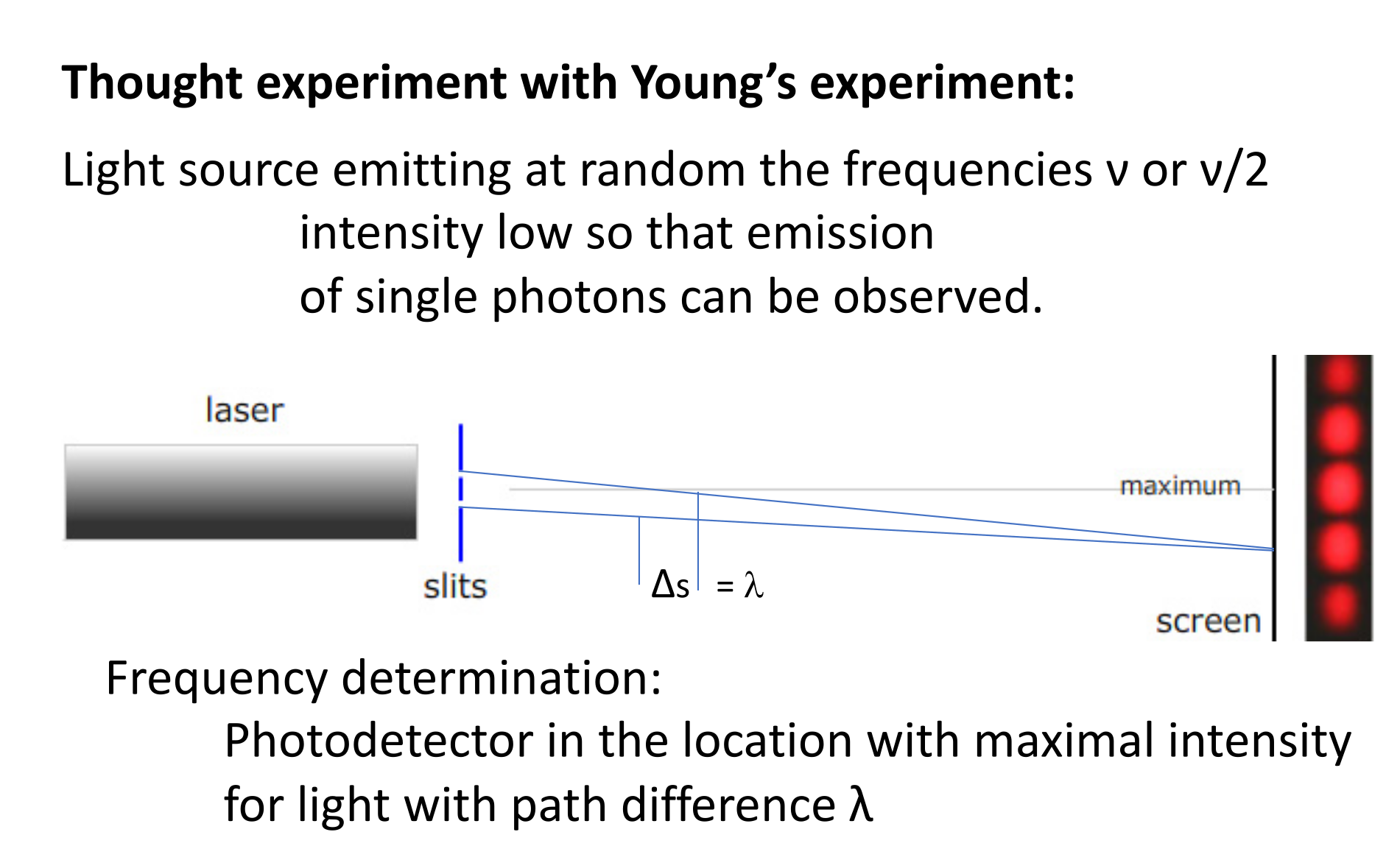
The photodetector is positioned behind the slits so that the two paths from the slits to the detector differ by one wavelength λ. If a photon reaches this location, it can only have the energy E = hν, since a photon with frequency ν/2 cannot arrive there under the stipulated interference condition.
The experimental system therefore consists of a double slit, a photodetector at a specially selected position, and one photon representing one bit of information. To transfer the photon’s information into our world, its presence at the detector must be detected. Detection is identified here with absorption.
The photon in its eigen-world is neither particle nor wave but the elementary unit of information, 1 bit. The interaction between the photon in its eigen-world and the macroscopic world begins at the double slit, where the photon manifests itself as a wave in the double-slit arrangement. From the double slit, the wave propagates at the speed of light. The absorption process begins when the wave reaches the detector along the shorter path and is completed when it reaches the detector along the longer path.
The duration of absorption is therefore
Δt = λ/c.
The information transfer from the photon’s eigen-world to the detector is consequently characterized by the elementary information flux
i₁ = 1 bit / Δt = c/λ bit/s.
Since ν = c/λ, Planck’s formula can then be written as
E = hν = h i₁.
In this interpretation the photon energy is equal to Planck’s constant h multiplied with the elementary information flux.
Energy Hypothesis for a Complex Information Flux
For the transmission of a complex signal containing n bits, a complex information flux I is introduced. If the transmission of n bits takes place during a time interval Δt, the corresponding time interval per bit is Δt/n, and the information flux becomes
I = n i₁.
The gedankenexperiment described above consists of a double slit, a photodetector, and one bit of information in the form of a photon. The absorption of the photon, or the decrease of information in the experiment by 1 bit, leads to an increase in energy at the detector. Accordingly, in the proposed generalization, a positive information flux is associated with negative energy:
−E = Ih.
These considerations lead to the hypothesis of a generalized energy-conservation law:
E + mc² + Ih = constant. [21]
A flux of complex information may be generated by reproducing stored information or by transforming pure information into an information flux.
An example of the latter is the spoken Word of God. In creation, God transformed His eternal plan or Word (Greek logos) into the spoken word (Greek rhema).
Additionally, in Hebrews 1:3 the spoken word is “the word of His power,” by which God upholds all things. This biblical statement led me to the idea that the dark energy invoked by astronomers to explain the accelerated expansion of the universe might be related to this “word of His power.”
The unidirectional flow of time in our world is one of the major problems in physics. Penrose [19] argued that a fine tuning of approximately 1/e10123 is required to explain the low-entropy initial condition associated with the arrow of time. This corresponds, in information-theoretic terms, to approximately 10123 bits.
According to the hypothesis presented above, we can estimate the energy associated with this information if it is assumed to flow through the universe. The longest possible duration of such a flow would be the age of the universe. Planck’s constant multiplied by 10123 bits and divided by approximately 14 billion years gives the corresponding negative energy rate. Dividing this by the volume of the observable universe gives an estimated energy density of approximately 10−15J/cm³, which is of the same order of magnitude as the observed dark-energy density.
A negative energy density acts as a pressure in the proposed analogy, and such a pressure could cause the accelerated expansion.
Feasibility of an Experimental Test of the Hypothesis
An experimental test of the proposed information–energy equivalence may be possible by measuring the repulsive force between two optical fibers carrying a high-rate information flux [22].
The proposed force relation is
F = (E/A)L,
where
E = I_flux h,
A = πd²/4,
L = 1 cm,
and d = 10−6 m.
For an information flux of
I_flux = 20 Tbit/s,
the predicted force is approximately
F = 169 pN.
As information flux, computer software with low redundancy may be used and as control a signal with 100% redundancy (10101…).
A force-measuring instrument has been developed by the Physikalisch-Technische Bundesanstalt (PTB) with a measurement range of 0.1 pN ≤ F_m < 10 μN and a stated uncertainty of 10−3 at 1 nN [23].
The experiment would provide a direct test of the proposed hypothesis. In particular, the decisive question is whether a repulsive force in the experiment with computer software can be detected in comparison to a control situation with a signal without information.
Conclusion
An experimental test of the proposed equivalence between information flux and energy is a necessary next step toward a quantitative theory of information in physics.
The three-worlds view is supported by several lines of philosophical and scientific reasoning, although it is not generally accepted within the scientific community. One reason may be the dominance of naturalistic approaches in contemporary science.
Penrose presented his three-worlds view in The Road to Reality [3]. The philosopher Thomas Nagel argued for a broader conception of nature in Mind and Cosmos [24]. In a different tradition, Francis Bacon spoke of “God’s Two Books” – the Book of Nature and the Bible.
The present article is intended as a hypothesis-generating contribution. Its central experimental proposal is deliberately formulated so that it can be tested independently of the theological interpretation. A positive or negative experimental result would therefore be scientifically informative: it would either support the proposed relationship between information flux and force or place a quantitative constraint on the hypothesis.
Literature
1. Wheeler, J. A., with Ford, K. Geons, Black Holes & Quantum Foam: A Life in Physics. New York: W. W. Norton & Co., 1998.
2. Popper, K. R. Three Worlds. The Tanner Lectures on Human Values, University of Michigan, 1978.
3. Penrose, R. The Road to Reality. Vintage, New York, 2007. ISBN 978-0-679-77631-4.
4. Weizsäcker, C. F. von. Die Einheit der Natur. München: DTV, 2002 (originally 1974). ISBN 978-3-423-33083-1.
5. Philo of Alexandria, De Deo 31–32, Internet Encyclopedia of Philosophy.
6. Philo of Alexandria, De Opificio Mundi 19, Internet Encyclopedia of Philosophy.
7. Philo of Alexandria, De Sacrificiis 65; De Vita Mosis 1.283.
8. Lennox, John C. Cosmic Chemistry: Do God and Science Mix? Kindle Edition.
9. Zeilinger, A. A Foundational Principle for Quantum Mechanics. Foundations of Physics 29 (1999), 631.
10. van Lommel, P. et al. Near-Death Experience in Survivors of Cardiac Arrest: A Prospective Study in the Netherlands. The Lancet 358 (2001), 2039–2045.
11. van Lommel, P. About the Continuity of Our Consciousness. In: Machado, C. and Shewmon, D. A. (eds.), Brain Death and Disorders of Consciousness. Advances in Experimental Medicine and Biology 550 (2004), 115–132.
12. Parnia, S. Death and Consciousness – An Overview of the Mental and Cognitive Experience of Death. Annals of the New York Academy of Sciences 1330 (2014), 75–93.
13. Parnia, S. Lucid Dying: The New Science Revolutionizing How We Understand Life and Death. Kindle Edition.
14. Stapp, H. Quantum Theory and the Role of Mind in Nature. Foundations of Physics 31 (2001), 1465–1499.
15. Schwartz, J. M., Stapp, H. P., and Beauregard, M. Quantum Physics in Neuroscience and Psychology: A Neurophysical Model of Mind–Brain Interaction. Philosophical Transactions of the Royal Society B 360 (2005), 1309–1327.
16. Fell, J., Fernandez, G., Klaver, P., Elger, C. E., and Fries, P. Is Synchronized Neural Gamma Activity Relevant for Selective Attention? Brain Research Reviews 42 (2003), 265–272.
17. Zeilinger, A. The Message of the Quantum. Nature 438 (2005), 743.
18. Laughlin, R. B. A Different Universe: Reinventing Physics from the Bottom Down. Basic Books, New York, 2005.
19. Penrose, R. The Emperor’s New Mind. Oxford University Press, 1989.
20. Brukner, C. and Zeilinger, A. Young’s Experiment and the Finiteness of Information. Philosophical Transactions of the Royal Society A 360 (2004), 1061–1065.
21. Ising, H. Information and Energy (2022). figshare. https://doi.org/10.6084/m9.figshare.18865316.v2
22. Hu, H. et al. Single-Source Chip-Based Frequency Comb Enabling Extreme Parallel Data Transmission. Nature Photonics (2018). https://doi.org/10.1038/s41566-018-0205-5
23. Physikalisch-Technische Bundesanstalt (PTB), Nano-Force Measurement Technique, PTB.
24. Nagel, T. Mind and Cosmos: Why the Materialist Neo-Darwinian Conception of Nature Is Almost Certainly False. Oxford University Press, 2012. ISBN 978-0-19-991975-5.
(2026/08)